Why saving is hard
Saving means saying no to something now. That's hard for anyone. It's harder for children, because a week can feel very long at 7.
The good news: waiting is a skill. It gets better with practice.
Pick the right goal
- Their goal, not yours. Children wait longer for something they really want.
- Not too far away. For a 7-year-old, two to four weeks is plenty. Older children can wait longer.
- Easy to picture. Print a photo of it, and stick it on the jar.
Then work out the plan together.
You could say“The kite costs 20. You save 5 a week. How many weeks is that?”
Let your child find the answer: four weeks. Now the goal has a date.
Make progress easy to see
Children save better when they can see their money grow.
- Use a clear jar, so they can see the coins.
- Draw a ladder with one step for each week. Colour in a step each time they save.
- Count the money together on pocket money day.
The treat or the goal?
This is the moment that matters. Your child has saved 12. Then they see a treat for 3.
Don't decide for them. Help them see the choice.
You could say“You can buy it. Then you'll have 9, and the kite costs 20. Is that OK?”
Sometimes they'll buy the treat. That's fine. They'll see the goal move further away. Next time, they may choose differently.
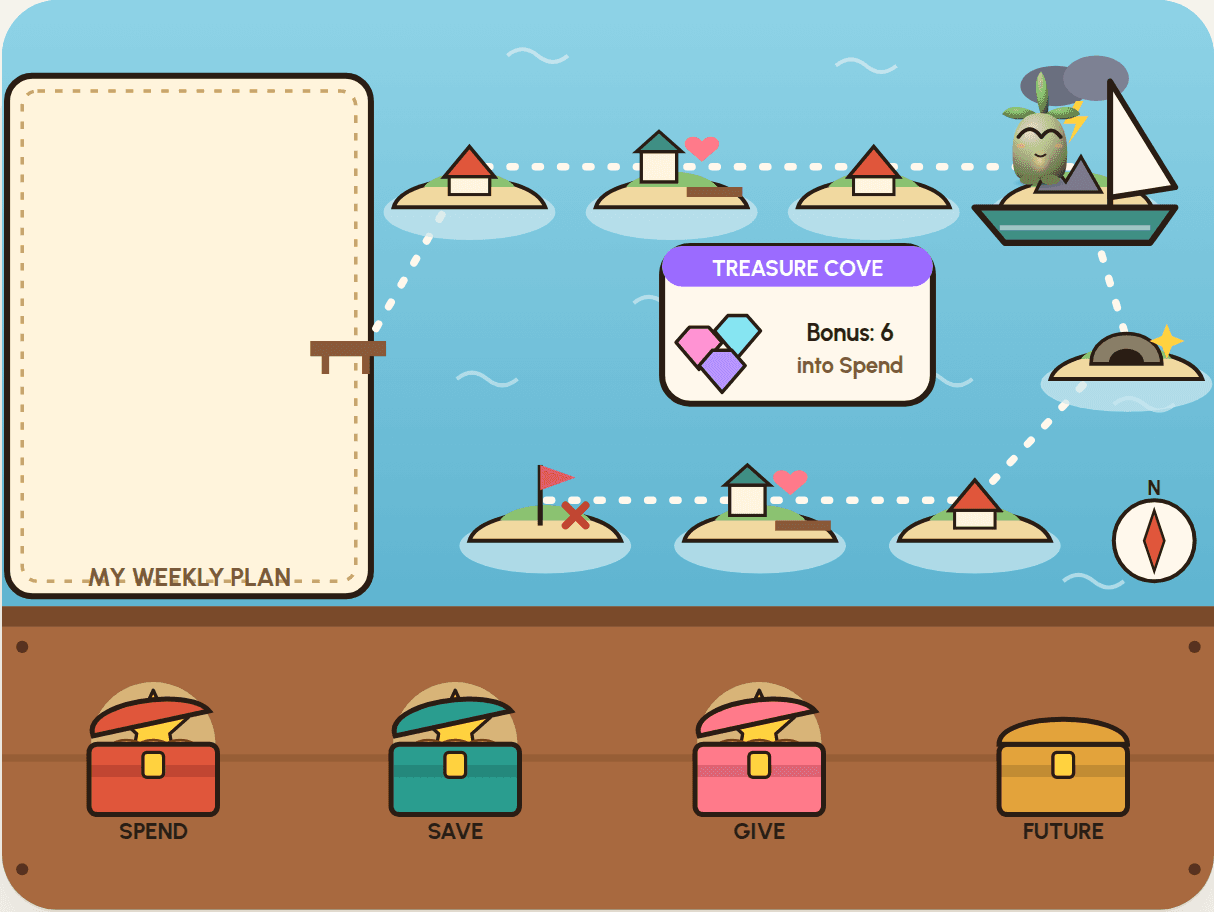
This is the choice in Market Day, our free pack. Treats float past at 3 coins each. Every coin saved lifts the kite higher. At 20 coins, it's Kite Day.
A little extra help
Some families add a bonus. For every 5 your child saves, you add 1. It makes saving feel worth it.
It's also a good way to explain interest later. Interest is a bonus the bank adds to money you save with it.
How saved money can grow
Older children can learn one more idea. When the bank adds interest, next year's interest is worked out on the bigger amount. So the money grows a little faster each year.
Put it in coins.
You could say“Every 10 coins grow 1 new coin each year.”
Start with 100 coins. After one year, there are 110. After two years, 121. After three years, about 133. After ten years, about 260. Left in a jar, it would still be 100.
Growth starts slowly, then speeds up. That's why starting early helps.
One honest note: real savings accounts usually grow much more slowly than this. The coins make the idea easy to see. In Coin Garden Time Machine, your child draws this growth as a chart, year by year.